Spur Herbicide 1 Gallon (clopyralid) NO SALES CA
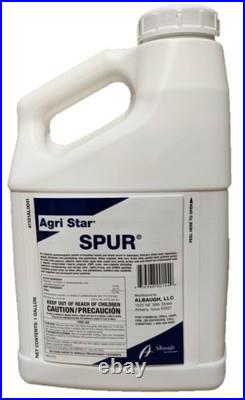

Spur Herbicide - Clopyralid 3 lb/gal for Thistle, Knapweed, Clover & Broadleaf Control in Pasture, Rangeland, CRP, Forestry & Rights-of-Way. Spur from Albaugh is a selective, postemergence herbicide formulated with the monoethanolamine salt of clopyralid at 40.9% (3 lb acid equivalent per gallon). Clopyralid is a Group 4 growth regulator that is absorbed by leaves and roots and moves throughout the plant, giving systemic control of the toughest perennial broadleaves - Canada thistle, musk thistle, knapweeds, yellow starthistle, clover, and dandelion - while leaving grasses unharmed. That makes Spur a go-to for cleaning up pastures, hayfields, rangeland, CRP acres, forest sites, and rights-of-way, with no grazing or haying restrictions at labeled rates on pasture and rangeland. It is also labeled for a long list of specialty and row crops, including corn, small grains, canola, sugar beets, and mint.
Systemic control of tough perennials - moves to the roots to control Canada thistle, musk and bull thistle, diffuse and spotted knapweed, and yellow starthistle. Grass-safe - controls broadleaf weeds without harming established grasses, including pasture and rangeland grasses. No grazing or haying restrictions on rangeland and permanent pasture at labeled rates.
Woody and vine activity - labeled for kudzu, mesquite (not in California), mimosa, locust, redbud, and wisteria, with cut-surface and stump options. Broad site and crop list - pasture, rangeland, CRP, non-cropland, forest sites, Christmas trees, corn, small grains, canola, sugar beets, mint, and more. Active Ingredient: Clopyralid, monoethanolamine salt - 40.9% (3 lb ae/gallon).
Formulation: Liquid concentrate; combustible; mix with water. Herbicide Group: 4 (Synthetic auxin/growth regulator). Re-Entry Interval (REI): 12 hours (WPS uses); for non-crop, pasture, and rangeland, keep out until sprays have dried.
Storage: Store above 28°F, or warm to 40°F and agitate before use. Use Sites & Target Vegetation. For use on: rangeland and permanent pasture, Conservation Reserve Program (CRP) acres with permanent grasses, non-cropland (rights-of-way, industrial sites, fencerows), forest sites and tree plantings, Christmas tree plantations, cottonwood/poplar and eucalyptus plantations, fallow cropland, and a wide range of crops including field, sweet, and popcorn, barley, oats, wheat, canola, crambe, sugar beet, garden beet, spinach, turnip, brassica leafy vegetables, asparagus, mint, hops, cranberry, perennial strawberries, stone fruits, apple, and grasses grown for seed. Controls: Canada thistle, musk thistle, bull thistle, artichoke thistle, Italian thistle, diffuse and spotted knapweed, yellow starthistle, dandelion, curly dock, clovers, cocklebur, ragweeds, sowthistle, sunflower, vetch, nightshades, wild buckwheat, horseweed, hawkweeds, and many others; suppression of Russian knapweed and perennial sowthistle; woody species and vines including kudzu, mesquite, mimosa (silktree), locust, redbud, acacia, and wisteria.
Does not control mustards, henbit, chickweed, kochia, lambsquarters, pigweed, Russian thistle, or field bindweed. Apply to actively growing weeds; Spur is rainfast in about 6 hours (2 hours for rights-of-way and kudzu uses). Adjuvants are generally not needed, though a nonionic surfactant is called for on non-cropland. Rates for the most common uses are below - see the label for crop-by-crop rates, growth stage limits, and harvest intervals. Rangeland & permanent pasture: 1/3 to 1-1/3 pt/A (max 1-1/3 pt/A per season); use the higher rates on established perennials. Musk thistle rosettes: 2/3-1 pt/A, or 1/3 pt/A tank-mixed with 2,4-D. CRP (permanent grasses only): 2/3 to 1-1/3 pt/A on actively growing thistles and knapweeds. Do not use where legumes or bentgrass are the desired cover.Non-cropland (all states except CA): 1/4 to 1-1/3 pt/A broadcast by ground or air with 1-2 qt nonionic surfactant per 100 gal. High-volume leaf/stem: 1-3 qt per 100 gal of spray. Cut-stump: 50/50 mix with water on freshly cut surfaces.
Forest sites: 1/4 to 1-1/3 pt/A depending on weed (kudzu and bull/musk thistle at the higher end); tank mixes with Garlon 4, Garlon 3A, 2,4-D, atrazine, Oust, or Velpar DF are on the label. Not for forest nursery beds. Kudzu (rights-of-way, roadsides, non-crop): 2/3 to 1-1/3 pt/A in late June to early October; total max 1-1/3 pt/A per season. Fallow cropland: 1/4 to 2/3 pt/A, higher rate for perennials; may be tank-mixed with 2,4-D. Field corn: 1/4 to 1/2 pt/A (Canada thistle 1/3-2/3 pt/A) from weed emergence through 5-leaf corn; max 2/3 pt/A per year. Barley, oats & wheat: 1/4 to 1/3 pt/A from 3-leaf to early boot; max 1/3 pt/A per season. Use at least 10 gal/A for best coverage and drift control (minimum 2 gal/A broadcast). Aerial application is limited to non-cropland and forest/rangeland-type uses plus spinach, canola, crambe, and sugar beets; it is not allowed on hops or other crops.Livestock moved from treated pasture should spend 7 days on untreated pasture before going onto sensitive broadleaf areas. Important restrictions: clopyralid is persistent in plant residues and manure - do not use treated hay, straw, grass clippings, or manure for compost or mulch where sensitive broadleaf crops will be grown. Avoid contact with vegetables, flowers, legumes, sunflowers, soybeans, potatoes, tomatoes, and other sensitive broadleaves, or soil where they will be planted that season.
Most states require 10.5 months before rotating to unlisted broadleaf crops, with a field bioassay recommended. Do not apply to water or use on rapidly permeable soils over shallow groundwater. Not for use in greenhouses or through chemigation. State limits apply: not approved in Arizona for agricultural or commercial plants including grazing areas, not for sale in Nassau or Suffolk Counties, NY, limited to agricultural, forest, and right-of-way sites in Oregon, and several crop uses are not registered in California. ALWAYS READ AND FOLLOW LABEL DIRECTIONS BEFORE USE.
Safety Data Sheet (SDS PDF). If your state is not listed, there are no restrictions in your state.Restricted - This State requires a license. Restricted - No sales to State.